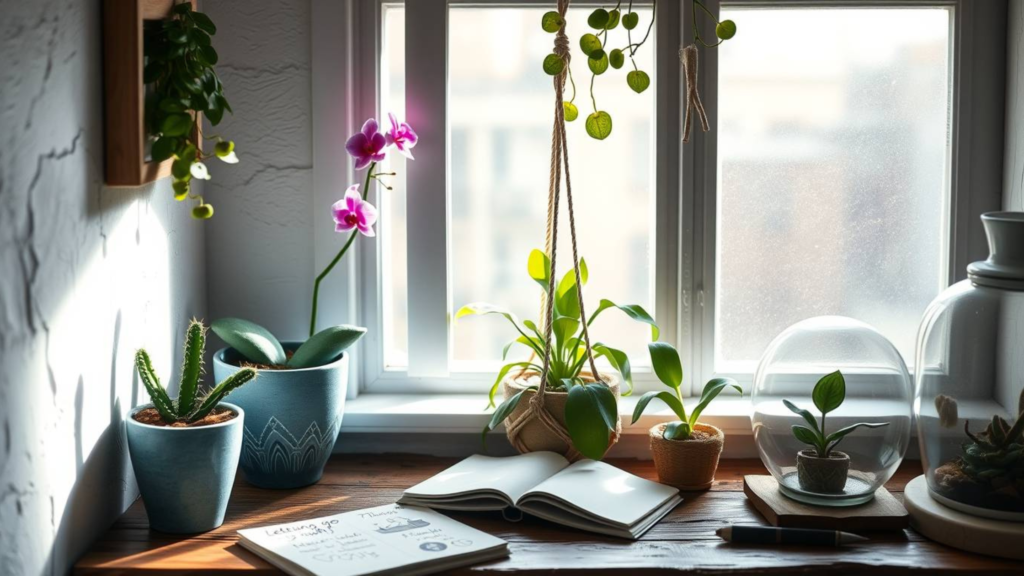

When I moved into my first apartment, the silence felt louder than the city traffic outside. The walls were bare, the floors echoed, and the air smelled like freshly painted loneliness. On a whim, I bought a tiny cactus from a street vendor. Its spines were soft, almost fuzzy, and it sat in a cracked ceramic pot the color of faded denim. I named it Spike. Little did I know, Spike would become the first of many green companions—each with their own quirks, demands, and quiet lessons on how to navigate life’s messiness.
This isn’t just a story about plants. It’s about how something as simple as a spider plant dangling from a macramé hanger or a fiddle-leaf fig shedding its leaves can mirror our own struggles, joys, and quiet rebellions. Let’s dig into the dirt together.
Lesson 1: Roots Need Room to Grow (So Do We)
Spike the cactus thrived for months without attention. I’d forget to water it, and it didn’t care. Then one day, its pot cracked clean in half. Turns out, Spike’s roots had grown so thick they’d outgrown their home. I repotted it into something bigger, but not before realizing: Aren’t we all a little like this?
We cling to routines, relationships, or jobs that feel safe but stifle us. Plants don’t apologize for needing space. They push against their confines unapologetically, cracking pots if they must. Humans, though? We’ll twist ourselves into bonsai shapes to fit someone else’s vision of who we should be.
My monstera deliciosa taught me the same lesson years later. Its aerial roots crept out like wild tentacles, demanding a moss pole to climb. Without support, it flopped sideways, leaves yellowing. I resisted buying the pole—“It’s fine, it’ll adapt”—until I caught myself doing the same thing: staying in a job that left me emotionally starved because change felt too daunting. The monstera got its pole. I quit my job. We both grew taller.
Lesson 2: Imperfection Is Not a Death Sentence
Fernando (Fernie, for short) was a Boston fern I adopted during a rainy autumn. Ferns are notoriously dramatic. Too much sun? Crispy fronds. Not enough humidity? Crispy fronds. Forget to water it for two days? You guessed it—crispy fronds.
For months, I nursed Fernie like a helicopter parent, misting it thrice daily and fretting over every brown tip. Then I went on a weeklong vacation. I returned to a plant that looked like it had been through a paper shredder. Half its fronds were dead, the soil was drier than a stand-up comedian’s wit, and I was certain it was a goner.
But here’s the thing about ferns: They’re resilient. I trimmed the dead bits, soaked the roots, and within weeks, new fiddleheads unfurled like shy ballerinas. Fernie didn’t care that it wasn’t Instagram-perfect. It just… grew.
We’re taught to hide our “crispy edges”—the burnout, the failed relationships, the days we can’t get out of bed. But plants don’t waste energy pretending. They shed what no longer serves them and redirect their resources. Maybe we could afford to do the same.
Lesson 3: Letting Go Hurts. Do It Anyway.
The hardest lesson came from an orchid named Persephone. Orchids are divas. They demand indirect light, precise watering, and airy potting mix. For two years, Persephone bloomed reliably, her flowers like delicate purple moths. Then, nothing. No buds, no stalks—just a stubborn green lump of leaves.
I tried everything: fertilizer, repotting, talking to her (don’t judge). Still, nada. My frustration grew. “After all I’ve done for you!” I’d mutter. Then, on a winter morning, I noticed her oldest leaf yellowing. Panicked, I Googled solutions. The answer? “Sometimes, orchids abort old leaves to focus energy on new growth. Let it fall.”
Letting go felt counterintuitive. What if she died? But I stopped poking her. I watered sparingly. And one day, a tiny green spike emerged from her base. By spring, she’d grown a stalk with twice as many blooms as before.
Persephone taught me that holding on too tightly—to expectations, to people, to versions of ourselves that no longer fit—can stifle rebirth. Not every ending is a failure. Sometimes, it’s just a plant’s way of saying, “Trust me. I know what I’m doing.”
Lesson 4: Growth Isn’t Linear (and That’s Okay)
Polly the pothos lives in my bathroom. She’s a trailing vine with heart-shaped leaves, and she’s… chaotic. Some stems grow a foot in a month. Others shrivel for no reason. Once, she lost all her leaves on one side, only to sprout new tendrils weeks later.
Polly’s erratic growth used to stress me out. “Why can’t you just be consistent?!” I’d groan, as if she owed me an explanation. But then I’d catch myself judging my own progress—comparing my career timeline to others’, fixating on setbacks instead of celebrating small wins.
Plants don’t measure their worth in inches per year. A stunted philodendron isn’t “failing.” It’s surviving. Maybe conserving energy for a future growth spurt. Maybe just existing, which is enough.
Lesson 5: You Can’t Control Everything (Stop Trying)
My final teacher was a venus flytrap named Vlad. Yes, I name all my plants. No, I’m not ashamed.
Venus flytraps are carnivorous, which makes them endlessly fascinating and utterly useless as pest control (they eat maybe one fly a month). But Vlad taught me about surrender. I’d fret over his humidity levels, his dormancy periods, his refusal to snap shut when I prodded him with a pencil. Then I realized: He’s not a toy. He’s a living thing with his own rhythm.
We’re obsessed with control. Diets, schedules, five-year plans—all attempts to domesticate life’s chaos. But Vlad thrives in swampy conditions I’d never choose for myself. He eats when he wants, ignores my deadlines, and still grows.
The Takeaway: Plants Are Better at Life Than We Are
In a world that glorifies hustle and perfection, plants are quietly rebellious. They wilt, adapt, shed, and bloom on their own terms. They don’t apologize for taking up space. They don’t fear judgment when they outgrow a pot.
My apartment is now a jungle. Spike the cactus has produced offsets—tiny “pups” that cling to its base. Fernie’s fronds brush the ceiling. Persephone’s blooms scent the air like vanilla, and Polly the pothos has tangled herself around a bookshelf.
I still talk to them. Not in a “woo-woo” way, but in the way you’d chat with a friend who listens without interrupting. They’ve seen me cry over breakups, dance to bad ’90s music, and burn toast at 2 a.m. They don’t offer advice. They just… exist. And in their quiet, stubborn way, they remind me:
Growth is messy. Letting go is painful. But somewhere in the soil and the silence, there’s always a chance to begin again.
Epilogue: A Note to the Skeptics
If you’re rolling your eyes at the idea of plants having “life lessons,” I get it. But here’s my challenge: Buy a ZZ plant. Put it in a corner. Ignore it for a month. Water it when you remember. Watch it not only survive but thrive. Then tell me you don’t feel a tiny spark of respect—for the plant, and maybe for yourself.
After all, we’re all just trying to grow in our own imperfect way.